
What Does Negative Split Mean in Swimming?
A negative split means swimming the second half of one continuous swim or repeat faster than the first half, measured by time over equal distances. Feeling that you worked harder is not enough: the back half must actually take less time.
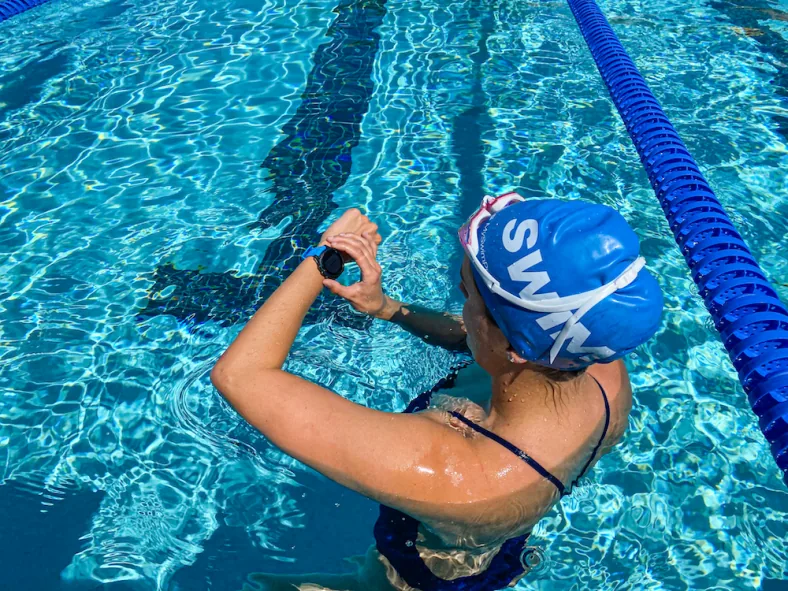
Record halfway and finish times. Contextual image; no automatic split accuracy is implied.
What counts as a negative split over 100, 200 or 300?
Compare the elapsed times for the two halves. U.S. Masters Swimming defines a negative split as a faster second half; equal times are an even split, and a slower second half is a positive split.
These are illustrative calculations, not prescribed workout targets. Distances can be metres or yards, but keep the same unit throughout each swim.
Worked split examples
| Timing check | 100 | 200 | 300 |
|---|---|---|---|
| Compare | 50 + 50 | 100 + 100 | 150 + 150 |
| First half | 0:55 | 1:55 | 3:00 |
| Second half | 0:52 | 1:50 | 2:54 |
| Total | 1:47 | 3:45 | 5:54 |
| Negative split by | 3 seconds | 5 seconds | 6 seconds |
For the 200 example, 3:45 minus 1:55 gives a second 100 of 1:50. By contrast, 1:55 followed by 1:55 is even; 1:55 followed by 2:00 is positive. Sprinting the last 25 does not change that classification if the whole second 100 still takes longer.
A plain negative-split 300 compares two 150s. USMS also describes the more specific instruction “negative split by 100s”: each successive 100 gets faster within that continuous 300. Read the qualifier before choosing where to check the clock.
How is negative split different from build and descend?
Negative split describes pacing inside one continuous swim. Descend describes faster times across separate repetitions, a distinction made explicitly by USMS. Build is a gradual increase in speed within a swim, often described length by length.
Three pacing instructions
| What changes? | Negative split | Build | Descend |
|---|---|---|---|
| Scope | One continuous swim | One continuous swim | Separate repeats in a set |
| Instruction | Back half faster than front half | Increase speed progressively | Each specified repeat faster than the previous one |
| Check | Compare equal-half times | Check the requested progression | Compare total repeat times |
A well-executed build can also produce a negative split, but negative split does not require every length to be faster than the previous one. For more notation, see how to read a swim workout.
How do you swim and verify a negative split?
Start at a controlled pace that leaves room to close faster. USMS stresses checking actual times and describes an open turn at halfway to see the clock; perceived effort alone cannot establish the result.
On a clock that repeats every minute, track elapsed minutes as well as the hand position. If you miss halfway, mark the split as unverified rather than guessing. Our pace-clock guide covers reading the clock, and the swim pace calculator guide helps translate pace into distance targets.
How should you record negative-split targets with AquaPlan?
Use the AquaPlan workout builder to prepare the session, and keep the pacing instruction with your workout notes. Write the checkpoint, both intended half-times and the purpose, such as “controlled opening, faster close.”
After swimming, record actual halfway and total times alongside those targets in your training log. For example: planned halves 1:55 / 1:50; actual halves 1:56 / 1:52; total 3:48; negative split by 4 seconds. That achieves the pacing pattern while missing the planned total by 3 seconds—two useful observations to keep separate. If using watch data, check that its segments match your halfway distance before comparing them; a workout label is not proof of the result.
Frequently Asked Questions
Does negative split mean the second half feels harder?
Where is halfway in a negative-split 300?
Do I rest halfway through a negative split?
Sources and limitations
Sources checked September 28, 2026: the USMS explanations below. The numerical examples are illustrative arithmetic, not measured swimmer results. Limitations: this source-based guide does not establish an ideal race strategy for every event, verify any watch’s split accuracy, or claim first-hand testing.
- U.S. Masters Swimming: Adult Swim Training
- U.S. Masters Swimming: How to Train for Middle-Distance Swim Races
- U.S. Masters Swimming: What’s All This About Negative Splits?
Automated editorial check (daily-ai-v1): this article was authored using AI and checked through an automated editorial process. No human expert review is claimed.
Article publisher
Published and maintained by AquaPlan. The article above identifies its evidence sources and automated editorial process; no human expert review is claimed.