
What SWOLF Means on a Swim Watch
SWOLF adds your time in seconds for one pool length to your swimming stroke count for that length. Use it to compare similar repeats in the same pool; it cannot judge every set or fairly compare different swimming styles and distances.
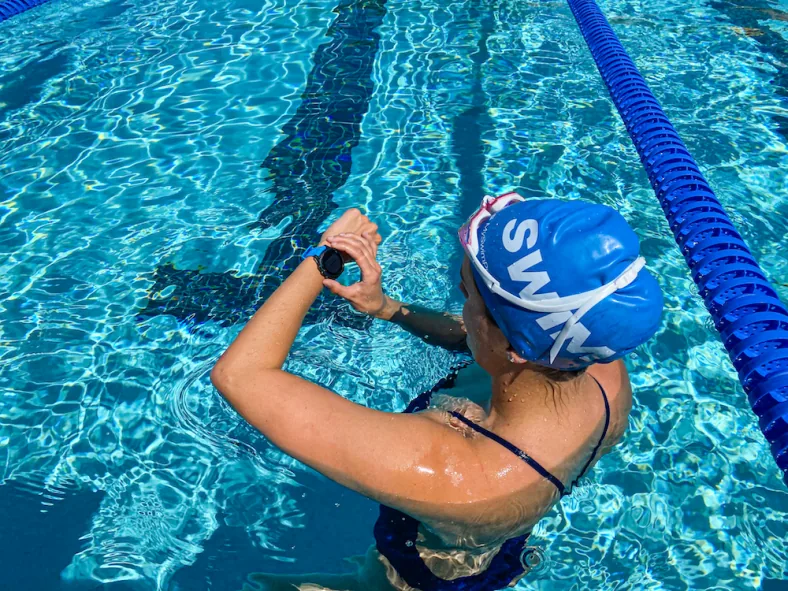
Check the length time and arm-cycle count behind the total before deciding what changed.
How is SWOLF calculated on a Garmin watch?
SWOLF = seconds per pool length + swimming stroke count per length. Garmin counts a full cycle of the watch-wearing arm. For freestyle, that differs from counting every hand entry, so use the same counting convention when checking the arithmetic yourself.
The Approach S62 manual gives the same definition as the Forerunner 265: a length is one trip down the pool, while an interval contains one or more consecutive lengths. Garmin describes SWOLF as a swimming-efficiency measure where lower is better. Our interpretation below adds context to that simple rule; the total alone does not show how it was achieved.
Can a lower SWOLF mean faster swimming or fewer arm cycles?
Either can lower the score. These two original, hypothetical examples each compare freestyle lengths in a 25m pool using Garmin’s watch-arm counting convention. They illustrate the arithmetic, not measured results or target scores.
Example 1: faster at the same count
| One 25m length | Earlier length | Later length |
|---|---|---|
| Time | 28 seconds | 26 seconds |
| Watch-arm cycles | 18 | 18 |
| SWOLF | 28 + 18 = 46 | 26 + 18 = 44 |
The two-point drop comes entirely from time. The swimmer covers the same distance two seconds faster with the same count. That is useful information for a pace-led repeat, but the score does not tell you whether the effort was comparable.
Example 2: fewer cycles at the same time
| One 25m length | Earlier length | Later length |
|---|---|---|
| Time | 28 seconds | 28 seconds |
| Watch-arm cycles | 18 | 16 |
| SWOLF | 28 + 18 = 46 | 28 + 16 = 44 |
This identical two-point drop comes entirely from the count. It does not represent faster swimming. If that later length also took 26 seconds, both inputs would fall and the total would be 42. Always read the pair of inputs alongside the total.
Can I compare SWOLF across pools or swimming styles?
Keep comparisons within the same pool length and swimming style. A 50m length covers twice the distance of a 25m length, so its time and count describe a different task. Metres and yards also differ. Do not treat raw totals from these settings as an improvement chart.
For a useful personal comparison, also match repeat distance, intended pace, and equipment. A short freestyle repeat and a longer breaststroke repeat ask different questions. A mixed-session average can hide those differences; select comparable lengths rather than chasing one whole-workout score.
When should I stop trying to lower SWOLF?
Our practical recommendation is to set SWOLF aside when it competes with the task. For sprint or intentionally high-rate swimming, prioritize the planned speed or cadence. Removing arm cycles just to lower the total can move you away from that objective.
Drills deliberately change normal swimming mechanics; kick work is not a normal arm-cycle comparison either. Judge whether you completed the intended drill or kick task. See the Garmin Drill Log guide for recording those parts separately.
How should I use SWOLF after a pool workout?
Start with the purpose written beside the set, then select similar repeats and inspect their length times and counts. Use the AquaPlan workout builder to label that purpose before swimming: steady freestyle, sprint, drill, or kick. This makes the later choice of review metric deliberate.
For a pace-focused review, the swim pace calculator guide explains time per distance. If interval boundaries look inconsistent, consult Auto Rest versus manual rest before interpreting small changes. SWOLF arithmetic cannot establish that the underlying recording is correct.
AquaPlan’s recommendation
Use SWOLF as a comparison tool for similar pool repeats.
Keep the set’s purpose first. Read time and arm-cycle count together, and leave the score out of decisions where sprint speed, a drill task, or planned cadence matters more.
Frequently Asked Questions
What is a good SWOLF score?
Does Garmin count both arms for SWOLF?
Is pool SWOLF calculated per length or per interval?
Which sources explain the SWOLF formula?
Sources checked September 27, 2026: Garmin’s Forerunner 265 and Approach S62 Swim Terminology pages. Limitations: this is a manual-based explanation with original arithmetic examples, not first-hand watch testing. The sources define the metric; they do not establish universal target scores or every model’s summary averaging. Set-selection advice is AquaPlan’s interpretation of the formula.
Automated editorial check (daily-ai-v1): this article was authored using AI and checked through an automated editorial process. No human expert review is claimed.
Article publisher
Published and maintained by AquaPlan. The article above identifies its evidence sources and automated editorial process; no human expert review is claimed.